Accounting · Process improvement · Systems

An accountant who builds the systems.

I'm a BYU accounting graduate, and I build tools that replace the spreadsheets and manual checks I'd otherwise spend my week on: order books, reconciliations, and close-style checklists. Everything below is something I designed and built. Most of it you can try right here.

The write-ups below are the technical versions. Switch to everyday phrasing →

3.9
GPA, BYU Marriott, B.S. Accounting
7
Projects designed and built
400
Automated test files across them
1
Peer-reviewed paper on accounting tech

Thanks for stopping by.

I'm looking for an analyst role in accounting or finance where process improvement and systems work are part of the job: financial systems, accounting operations, FP&A, or a team that wants someone to automate its own processes.

  • Accounting foundation: B.S. Accounting, BYU Marriott (3.9 GPA). Coursework in AIS, COSO, COBIT, and ITGC.
  • Experience: tax work at a regional CPA firm, payment-processing sales analysis, and bookkeeping (QuickBooks, ASC 606 recurring entries, and reconciliations).
  • Systems: I build working tools in Python, SQL, and JavaScript, including a reconciliation engine with explainable match scores and a FIFO inventory ledger for my own business.

The two demos most related to accounting work are Commander Capital Console (order costing, FIFO COGS, and a general ledger) and Wheel (bank-to-books reconciliation).

Contact

Based in Provo, Utah. Open to hybrid in Utah County or remote.
Résumé at a glance

Education

Brigham Young University, Marriott School of BusinessAug 2025
B.S. Accounting · GPA 3.9 · Dean's List (top 5%) W2023, Sp2025
  • Relevant coursework: Accounting Information Systems, COSO, COBIT, and ITGC

Experience

Larry Cox and Associates CPA, Lehi, UTAug 2026 – Sep 2026
Client Tax Manager
  • Advised clients on tax strategy and obligations to employees, the IRS, and CPA/law firms
  • Analyzed financial data for partnerships, corporations, and non-profits to assess tax compliance
  • Consolidated dozens of training documents into one comprehensive manual
Redrock Payments, Grayson, KYSep 2025 – Apr 2026
Sales Representative, payment processing
  • Built proposals from transaction volume, industry, and location data with clear cost and savings estimates
  • Met directly with small-business owners to explain processing costs
The Back Nine Golf, Carmel, IN (remote)Jan 2025 – Apr 2025
Bookkeeping Intern
  • Classified transactions in QuickBooks for CPA review ahead of tax filing
  • Automated recurring subscription journal entries in line with ASC 606
  • Reconciled monthly bank and credit card statements

Projects

  • Commander Capital: founder of an e-commerce business selling custom card-game decks, $4,500+ revenue at a 40% margin, run on the console demoed below
  • Wheel: financial data integration and reconciliation platform (Python, Flask, PostgreSQL, QuickBooks and bank APIs, and agentic AI with a written governance constitution)
  • TechHub.training: co-developed an accounting-technology education platform with 260+ challenges and 11,000+ visitors; co-authored a peer-reviewed paper on technology in accounting education (Mar 2026)

Skills

Excel, Alteryx, QuickBooks, SQL, Python, Power BI, JavaScript/Node, and PostgreSQL. Data validation, financial reconciliation, AI-assisted development, and automation.

The work

Live demos run the production code on sample data, each with a guided tutorial. Repositories stay private. Switch to everyday phrasing
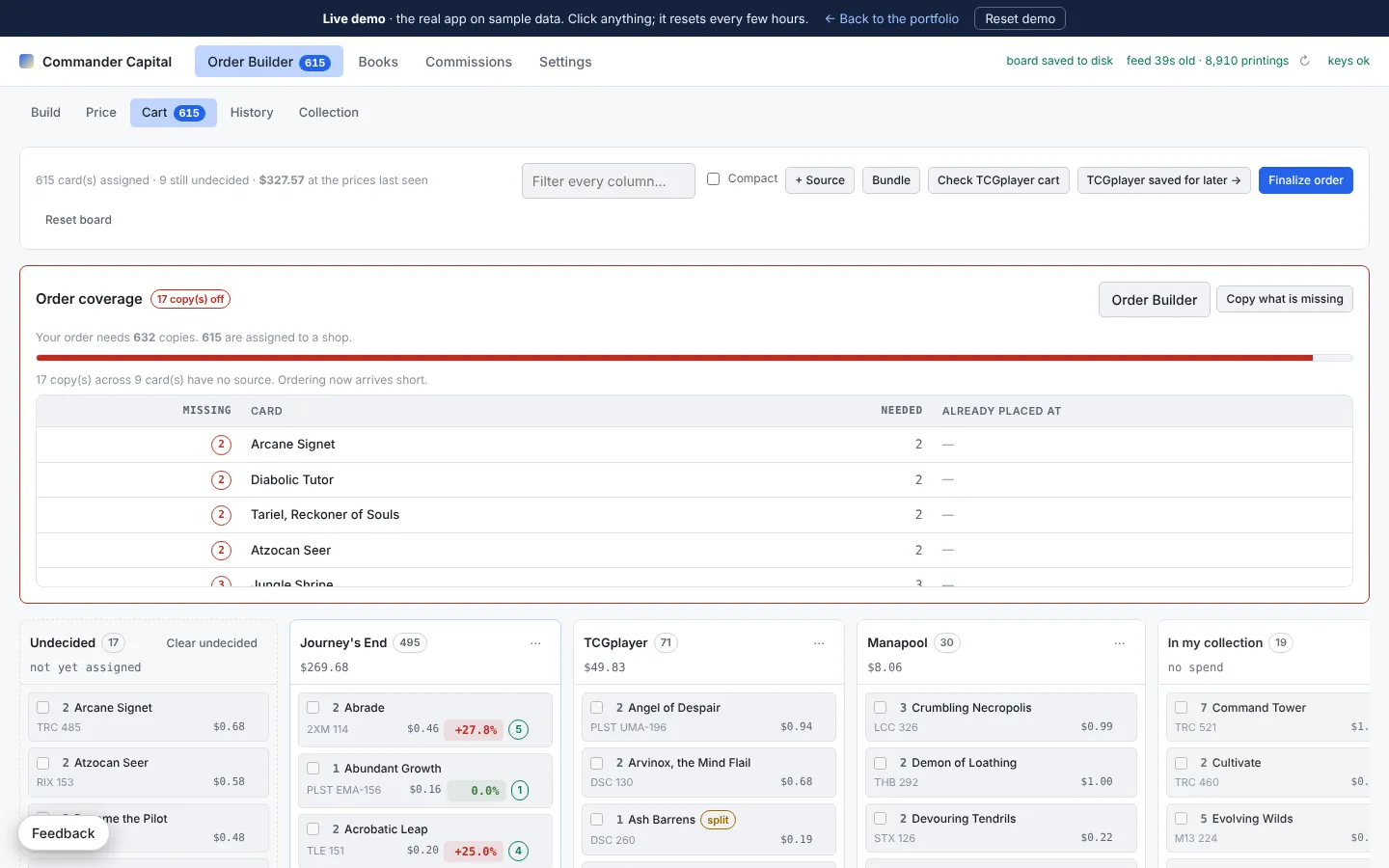
Commander Capital Console's sourcing board, with an order coverage warning that 17 copies have no source
Live demoNode · Express · vanilla JS

Commander Capital Console

A Node/Express app with a vanilla-JS front end that replaced two Excel workbooks. It consolidates deck lists into one buy order, prices it against a store's API and Scryfall market data, splits sourcing across vendors on a drag-and-drop board, enforces a copy-level coverage invariant before an order can be finalized, and keeps books with FIFO COGS, an eBay Sell API sync, and a derived double-entry general ledger.

Process redesignFIFO COGSGeneral ledgerAPI integrationControls
Try this in the demo:
  1. Run the built-in tutorial: it drives one order through Build → Price → Cart → History using the app's real handlers.
  2. Books → General ledger: the journal and trial balance derived from the sales ledger and lots.
  3. Books → Sync eBay: runs the real sync and mapping code against a stand-in eBay client.
What's under the hood
  • Invariant: copy-level coverage reconciliation between the consolidated order and every vendor list, keyed by Scryfall ID and finish. Splits across vendors must sum before they apply; finalize refuses short orders.
  • Books: eBay Fulfillment and Finances APIs (OAuth refresh-token flow) mapped to per-line sales, with fees, ad fees, labels, and refunds allocated by largest remainder; Mercari CSV import; FIFO COGS against built lots plus per-deck fixed costs; and a journal and trial balance derived from the ledger.
  • Persistence: atomic JSON writes with restore points and optimistic concurrency (revision checks reject stale writes).
  • Scale: ~23k lines and 34 test files (node:test plus Playwright end-to-end drag-and-drop tests).

Demo: je-client.js and ebay-client.js are stand-ins with the same exports serving deterministic sample data. Everything downstream is production code.
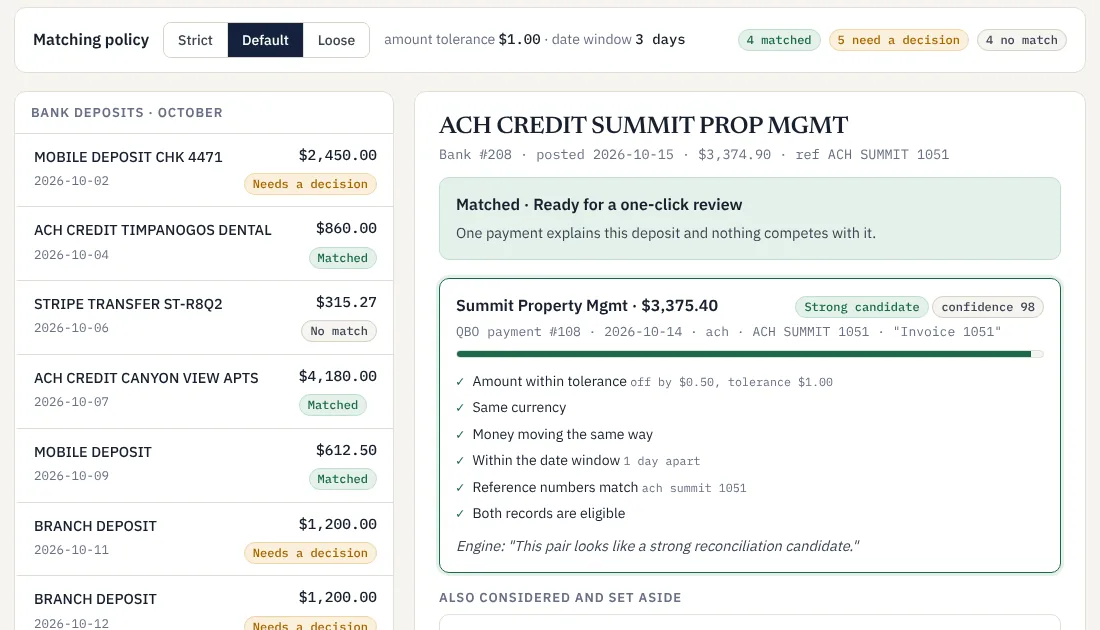
Wheel's reconciliation explorer matching bank deposits to QuickBooks payments
Interactive demoPython · Flask · PostgreSQL

Wheel: one hub for every system's numbers

A hub-and-spoke integration platform. Vendor adapters ("spokes") pull from QuickBooks Online and bank feeds through a seven-stage pipeline into a tenant-scoped canonical store. A reconciliation engine scores payment-to-deposit pairs on amount, date, reference, and direction signals, explains each decision, routes near-ties to human review, and pushes approved results back to the spokes.

ReconciliationAudit trailQuickBooks APIAI governance
Try this in the demo: Step through the pipeline stages for one payment, resolve an ambiguous bundle yourself, and then switch the policy from Default to Loose ($15 / 5 days) to watch the Stripe payouts become candidates.
What's under the hood
  • Fetch → Normalize → Envelope (immutable, content-hashed) → Facts → Apply → Canon → Interface, with a provenance chain from VendorCallLog through SyncRun, envelopes, facts, and ApplyEvents to every canonical row.
  • Preview and apply are separate code paths; a preview never writes or advances the sync cursor. Outbound writes go through PushRun and external mappings.
  • A written governance constitution (permissions, standards, and prohibited actions) for the AI agents that contributed, with every change human-reviewed.

Demo data is produced by Wheel's real compare_pair, build_explanation, and build_candidate_bundle under three policies, on a sample month of books.

Live productFastAPI · PostgreSQL · React

Deck Synergy

A multi-tenant recommendation engine. It tags ~34,000 cards by strategy, scores candidates by synergy with a pasted decklist, and filters to each store's live inventory. Stores embed it on their own site with a JavaScript widget that hands picks to the store's cart.

Product buildInventory matchingMulti-tenantEmbeddable widget
How it grew
  • V1: Python and Streamlit over a local SQLite cache of ~34,000 cards and their strategy tags.
  • V2: FastAPI, managed Postgres, an APScheduler worker refreshing card data, a store dashboard, and a React widget build served as widget.js, deployed on Render.
Python · Claude API · Obsidian

Pocket Assistant

A scheduled Python pipeline: it pulls transcripts from the Pocket API, matches them to Google Calendar events by time overlap, writes recaps to an Obsidian vault, extracts commitments with Claude (timed ones become events, and date-only ones become tentative), and sends a structured digest. A weekly refiner proposes prompt edits scored against a gold set before a manual merge.

Scheduled pipelineCalendar matchingPrompt evaluation
PowerShell · Git worktrees · Telegram

Agent Orchestrator

An orchestrator for AI coding agents. A manager (Claude Opus) plans an idea into a dependency graph of tasks with difficulty tiers; a pool of up to five builders (Codex CLI and Claude Code, with model and effort chosen by tier) runs them in isolated git worktrees; deterministic scope and test validation gates every result; failed tries retry one tier up; and merges need a one-time-code approval over a Telegram bot.

Segregation of dutiesApproval workflowAudit trailParallel builds

Built primarily by the Orchestrator

Planned and implemented mainly through the orchestrator's manager/builder pipeline; I owned the specs, plan approvals, and merge reviews.

Live demoPython · FastAPI · SQLite

FamilyLedger

A local-first budgeting app: FastAPI, SQLite, server-rendered Jinja, and an installable PWA. It imports bank, card, and Venmo CSV exports with duplicate detection, applies merchant rules and matching, and serves a mobile sorter for the remainder, plus budgets with rollover, proportional savings goals, and a weekly import workflow with notifications.

Bank CSV importCategorization rulesBudgetsPrivacy by design
Design choices
  • No credentials or aggregator APIs: file imports only, and the data never leaves the machine.
  • Optional LLM chat through an MCP server exposing read-only tools.
  • 75 test files across import, matching, budgets, and the weekly workflow.
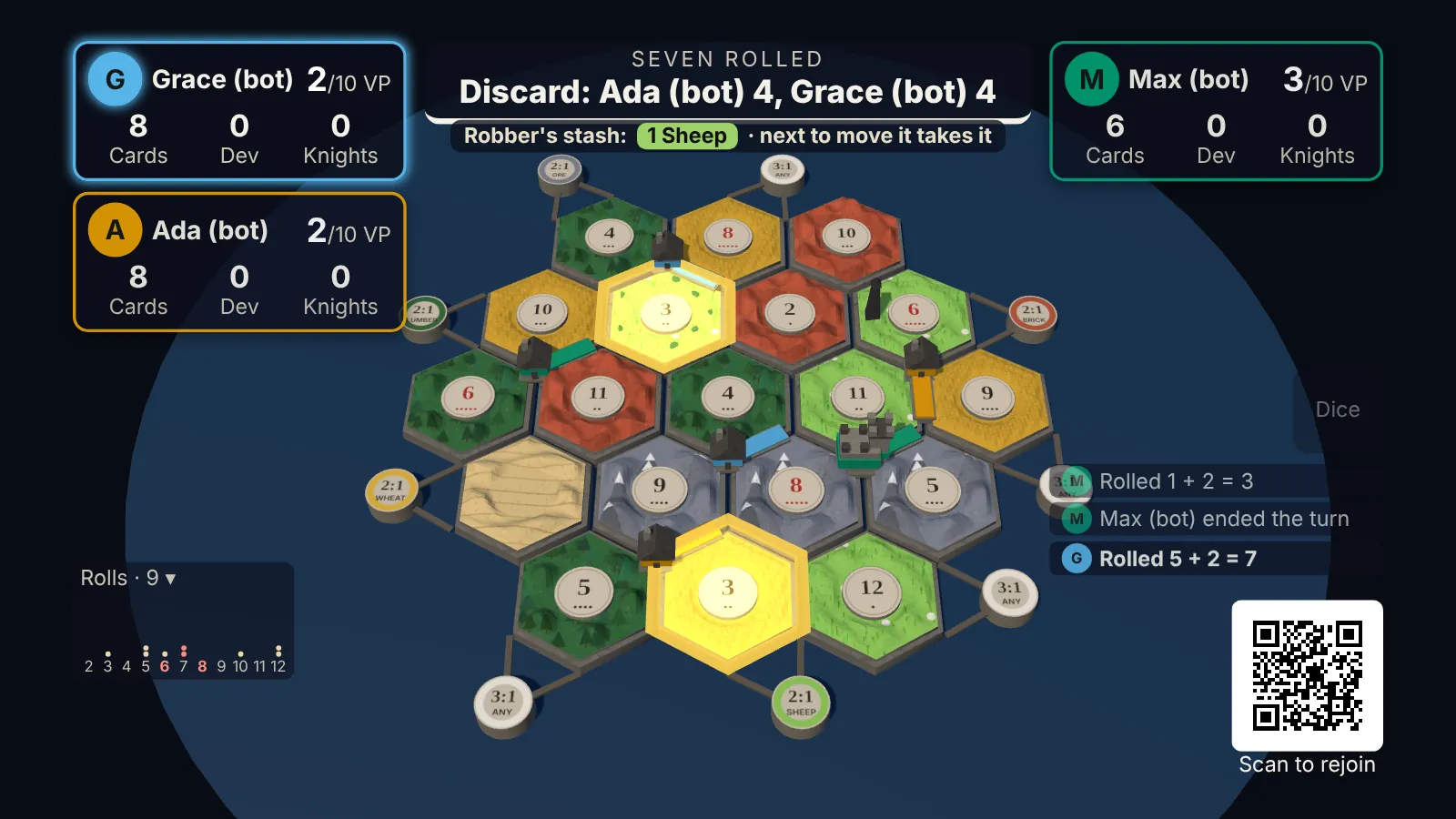
Couch Settlers' 3D board on a TV with three computer players mid-game
For funTypeScript · Three.js · WebSockets

Couch Games

A TypeScript monorepo: deterministic game engines, a Three.js table view, and phone clients synced over WebSockets behind a transport seam, with bots, undo, reconnects, and an online relay mode. 200+ test files.

Real-time syncGame engineBots200+ test files
Why it's here
It's the hardest state-consistency problem I've built: per-player hidden state, a shared authoritative board, reconnects, and undo, all converging on one game state. It also has the most tests of anything I've built.

About

I studied accounting at BYU because I like knowing exactly where the numbers come from. Along the way I found that the part of the job I enjoy most is fixing the process behind the numbers: the spreadsheet everyone's afraid to touch, or the reconciliation that takes a day because two systems disagree on a reference number.

So I build. Commander Capital started as a side business selling custom decks for a card game and turned into a lesson in costing, inventory, and controls. Wheel came from wanting reconciliation that explains itself. I co-authored a peer-reviewed paper on technology in accounting education and helped build TechHub.training, which has had more than 11,000 visitors.

Outside of work: sourdough and board games, and building games for my family to play.

Accounting

GAAP, ASC 606, FIFO costing, reconciliations, internal controls (COSO and ITGC), tax compliance, and QuickBooks

Data and analysis

Excel, SQL, Alteryx, Power BI, and Python (pandas)

Building

Python (Flask and FastAPI), JavaScript and Node, PostgreSQL, REST APIs, automated testing, and AI-assisted development

Welcome! What brings you here?

This just sets up the page for you. Everything on the site is open either way.

Only shared with James, so he knows who stopped by. Leave it blank if you'd rather.